
Holden Rodeo 4JH1 ECU Remap & Chip Tuning
More power. More torque. A completely different 4JH1 to drive.
The Holden Rodeo 3.0 TDi with the 4JH1 engine has earned a reputation for durability, but factory performance can leave a lot to be desired.
Our proven Holden Rodeo 4JH1 ECU remap transforms the way the engine delivers its power, with dyno-tested gains of up to 38 kW and 85 Nm of torque on our development vehicle.
105.2 hp → 152.9 hp
245.8 Nm → 318.8 Nm
And where it matters most, our testing recorded approximately 90 Nm of additional torque at 2,000 rpm.
More usable torque. Stronger acceleration. A 4JH1 that no longer feels like it is fighting against you every time you ask it to pull.
Australia-wide ECU mail-in tuning service available.

Proven 4JH1 performance gains
These are not generic figures taken from a tuning database.
We tested our Holden Rodeo 4JH1 before and after ECU calibration and recorded the results under measured conditions.
Stock power: 105.2 hp at 3,302 rpm
Tuned power: 152.9 hp at 3,775 rpm
Stock torque: 245.8 Nm at 2,518 rpm
Tuned torque: 318.8 Nm at 2,815 rpm
The biggest difference, however, is not simply the peak power figure.
Look at the torque curve.
At approximately 2,000 rpm, the tuned 4JH1 is producing around 90 Nm more torque than the standard ECU calibration.
That is the difference you actually feel when accelerating, climbing a hill or asking the engine to pull under load.
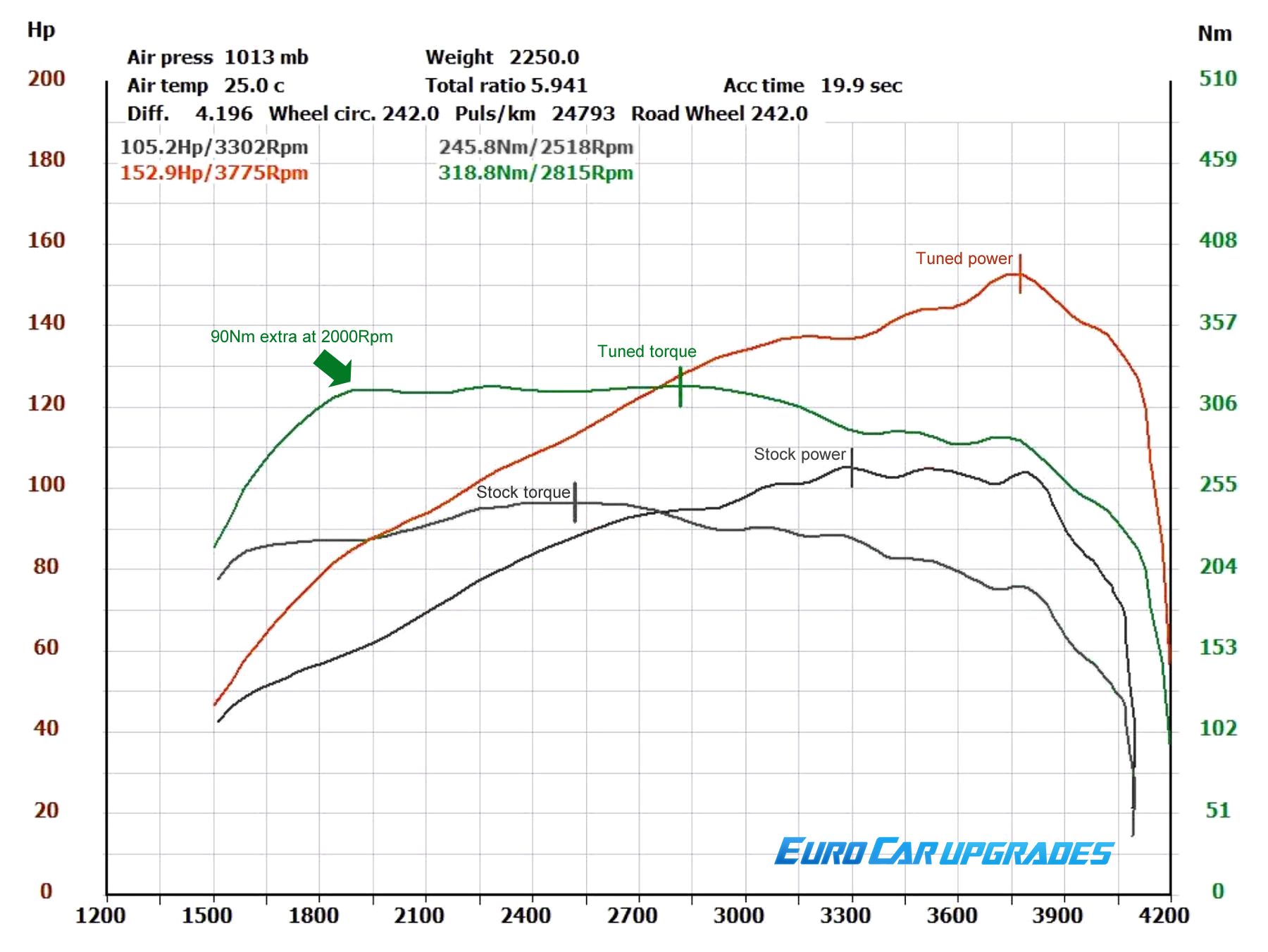
Dyno comparison from our Holden Rodeo 4JH1 development vehicle. Individual results may vary depending on vehicle condition, ECU software, hardware and vehicle modifications.
Watch the difference: Holden Rodeo 4JH1 acceleration
Numbers on a dyno graph are useful.
Seeing the difference on the road is even better.
Our 4JH1 ECU calibration was developed to improve usable torque and power delivery across the rev range — not simply chase a peak dyno number.
The result is a much stronger and more responsive engine where a Rodeo driver actually needs it.
Why does the Holden Rodeo 4JH1 feel underpowered?
The pre-common-rail 4JH1 is an older electronically controlled diesel platform with a conservative factory ECU calibration.
For many Rodeo owners, the lack of performance becomes particularly obvious when the vehicle is loaded, fitted with accessories or simply asked to accelerate at normal road speeds.
The engine may feel:
- Slow to respond under acceleration
- Flat through the mid-range
- Short of torque under load
- Reluctant when overtaking
- Noticeably affected by larger tyres
- Sluggish after adding a canopy, bullbar or other vehicle weight
A properly developed ECU remap changes the way the engine manages boost, diesel injection and air delivery.
Rather than fitting a generic plug-in device, we access and recalibrate the engine management software itself.
The result is a significantly stronger and more usable torque curve.
A proper 4JH1 ECU remap — not a plug-in power box
Our Holden Rodeo 4JH1 tuning process is very different from plugging a generic power box into the vehicle and hoping for the best.
On the ECU version used in our development vehicle, accessing the original engine calibration requires specialist electronic work directly on the engine control unit.
The ECU is opened and the relevant electronic device is professionally removed using controlled infrared rework equipment.
This allows us to access the original engine management data.
Our calibration engineers can then modify the relevant ECU maps and strategies associated with:
- Turbocharger boost control
- Diesel injection
- Air management
- Torque delivery
- Power delivery across the engine speed range
The modified calibration is programmed back into the engine ECU before the ECU is prepared for refitting and testing.
This is ECU calibration and automotive electronics work performed by specialists — not a generic tuning box intercepting sensor signals.
Developed from the original ECU calibration
Every engine ECU contains software that controls how the engine operates.
Within that software are calibration maps and control strategies used by the ECU to manage fuel delivery, boost, air management and numerous engine protection functions.
Our 4JH1 chip tuning process starts with the vehicle's original ECU data.
The calibration is analysed and the appropriate engine management areas are modified to improve the performance characteristics of the 4JH1.
The aim is not simply to change one value or force additional fuel into the engine.
We develop the calibration across the operating range to improve how the engine builds and delivers torque.
That difference can clearly be seen in our before-and-after dyno graph.
4JH1 tuning developed with testing, not guesswork
Before developing the calibration, the vehicle is checked for faults and its existing condition is assessed.
Following ECU tuning, the vehicle is checked again and the performance results are validated.
Our development process included dyno testing to compare the standard and modified ECU calibrations.
This gives us measurable data showing what actually changed.
It also allows us to analyse the shape of the power and torque curves rather than relying on a driver's impression that the vehicle simply “feels faster”.
For our Holden Rodeo development vehicle, the results showed a substantial improvement throughout the usable engine speed range.
The approximately 90 Nm torque increase at 2,000 rpm is particularly important because this is an area of the rev range frequently used during normal driving.
Holden Rodeo 4JH1 limp mode and EGR problems
EGR-related problems are a common frustration for owners of older Holden Rodeo and Isuzu 4JH1 vehicles.
Depending on the fault, the vehicle may experience:
- Engine or emissions warning lights
- Reduced engine performance
- Intermittent limp mode
- Poor throttle response
- Recurring EGR-related fault codes
It is important to understand that not every 4JH1 limp-mode problem is caused by the EGR system.
If your Rodeo is entering limp mode, tell us what the vehicle is doing and provide any diagnostic fault codes you have.
The ECU fault strategy and vehicle condition should be considered before deciding on the correct solution.
Rodeo going into limp mode?
Tell us what your 4JH1 is doing
How our Holden Rodeo 4JH1 tuning process works
1. Tell us about your vehicle
Complete our ECU tuning enquiry form with your vehicle make, model, year and engine details.
Tell us whether the engine is standard or modified and describe any current problems with the vehicle.
2. We confirm your ECU and tuning options
We review the vehicle application and confirm the appropriate tuning process.
Depending on the ECU and the work required, we will tell you whether we need the complete vehicle or only the engine ECU.
3. Send us your ECU
For suitable 4JH1 applications, customers anywhere in Australia can remove the engine ECU and send it directly to us.
Package the ECU securely and include the details requested by our team.
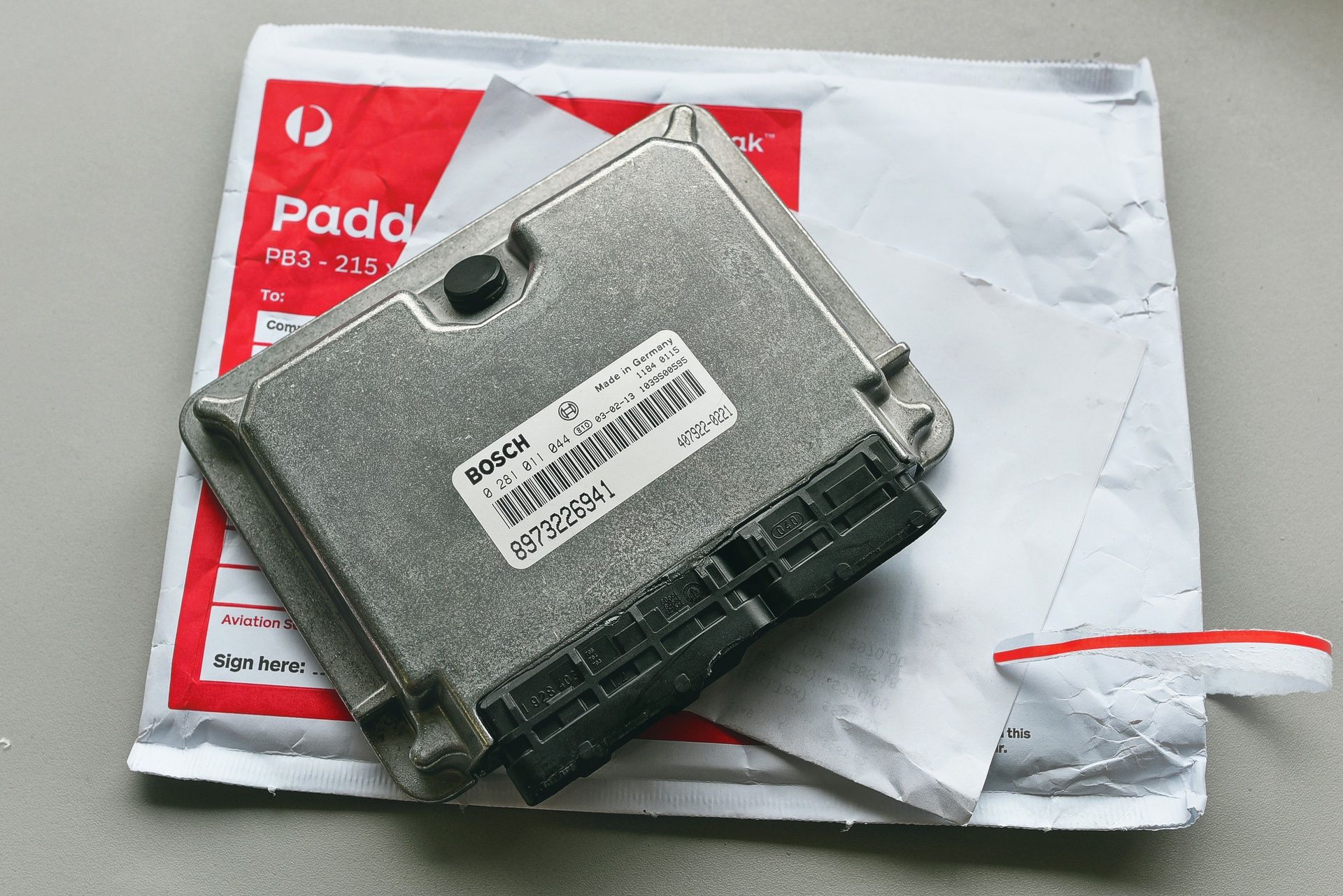
4. We access the original ECU calibration
The ECU data is professionally accessed using the appropriate electronics and programming process for the control unit.
We retain and work from the original ECU calibration.
5. Your ECU calibration is modified
The relevant engine management data is calibrated according to the agreed tuning requirements and vehicle setup.
6. The tuned ECU is returned
Once the ECU work is completed, the control unit is prepared for return.
You can refit the original ECU to the vehicle and complete any testing or diagnostic procedures advised by our team.
Modified turbo or larger injectors?
Not every 4JH1 is standard anymore.
We regularly receive enquiries about Rodeos and Isuzu vehicles fitted with engine modifications including:
- Larger diesel injectors
- Upgraded turbochargers
- Modified intake systems
- Exhaust modifications
- Other performance hardware
If your engine has been modified, tell us before ordering an ECU tune.
A calibration developed for a standard engine may not be appropriate for a significantly modified 4JH1.
Modified vehicles may require additional calibration work and testing.
For heavily modified applications, a custom tuning surcharge may apply and dyno testing may be recommended.
4JH1 EGR software calibration for off-road vehicles
The EGR system is a common source of problems on older Holden Rodeo and Isuzu 4JH1 engines.
Where a vehicle is used exclusively in an eligible off-road application — such as a farm vehicle, private property vehicle or competition vehicle — we can also discuss EGR-related ECU software calibration as part of the tuning process.
If the EGR valve is physically removed or blanked, the engine ECU may continue to monitor the EGR system and detect that the expected EGR operation is no longer occurring.
This can cause the engine or emissions warning light to appear on the dashboard and, depending on the ECU fault strategy, may contribute to reduced engine performance or limp mode.
For suitable off-road applications, the relevant EGR monitoring strategy can be recalibrated within the engine ECU.
This is commonly referred to as 4JH1 EGR off, EGR delete software or an EGR ECU fix.
Have a farm or off-road 4JH1 with recurring EGR-related problems?
Important information about EGR modifications
EGR software changes and emissions-control modifications are offered only for vehicles and applications where such modifications are lawful, including eligible vehicles used exclusively off public roads.
Euro Car Electronics and ECU Tunes do not authorise or recommend the use of an emissions-modified vehicle on public roads where the removal, disabling or alteration of emissions-control equipment is prohibited.
The vehicle owner or operator is responsible for ensuring the vehicle, its intended use and any requested modifications comply with the laws and regulations applicable to them.
Vehicles using the 4JH1 engine
We can assess ECU tuning applications including:
- Holden Rodeo 3.0 TDi 4JH1 — pre-common-rail
- Isuzu NKR200
- Isuzu NKR77
- Isuzu SiTEC 125
Have a common-rail Holden Rodeo?
We tune common-rail applications as well.
The ECU hardware, software and tuning process can vary between vehicles. Submit your vehicle details and we will confirm the appropriate ECU tuning options for your application.
Australia-wide 4JH1 ECU tuning
You do not need to be located near our workshop to enquire about a Holden Rodeo 4JH1 tune.
For compatible engine ECUs, we offer an Australia-wide mail-in ECU tuning service.
Remove the ECU, package it securely and send it to us.
Once the ECU application and tuning requirements are confirmed, our team can access and calibrate the original engine control unit before returning it to you.
This makes our 4JH1 ECU tuning service available to Rodeo and Isuzu owners throughout Australia.
Are you a workshop or diesel specialist?
ECU Tunes also provides tuning support for automotive workshops, diesel specialists and performance businesses.
Our dealer tuning portal allows approved trade customers to purchase tuning credits and submit ECU files from their own customer vehicles.
Read the ECU using your compatible tuning equipment, submit the original file to us and download the completed calibration when the tuning work is finished.
Ready to wake up your 4JH1?
If your Holden Rodeo feels flat, lacks torque or you simply want to know what is possible with your 4JH1 ECU, send us the vehicle details.
Tell us:
- Make and model
- Vehicle year
- 4JH1 engine application
- Whether the engine is standard or modified
- Current fault codes, if applicable
- What you want to improve
Our team will review the application and confirm the appropriate ECU tuning process.